Skip to content

Know When to Step In

· 2 min read · ai · engineering · agents

You ask someone a simple question on Slack. You get an essay back. Headers, bold bits, a little summary at the end. You ask again and it’s the same thing. Then it hits you, you’re not talking to them at all. You’re talking to a chatbot and they’re just standing in the middle.

That’s a meat proxy. Niklas Gruhn wrote about it in August and now there’s a whole site for it, meatproxy.me. It’s a joke site, but the joke is good.
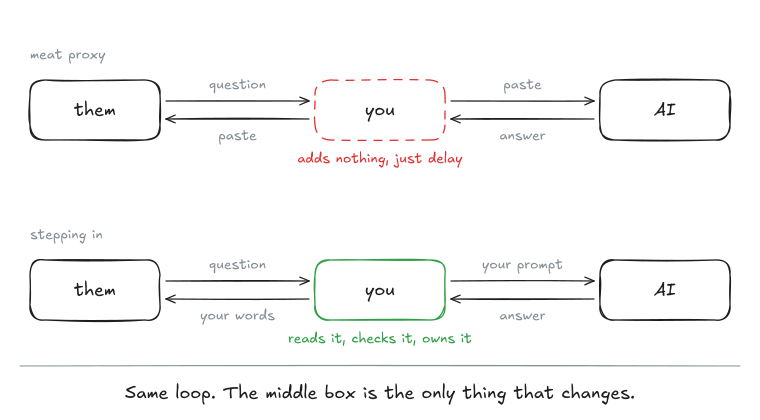
The same loop drawn twice: them, you, AI. In the first, labelled meat proxy, a question goes in, you paste it to the AI, the answer comes back and you paste it to them. The you box is dashed and marked: adds nothing, just delay. In the second, labelled stepping in, you send your own prompt and reply in your own words. The you box is solid and marked: reads it, checks it, owns it. The caption reads: same loop, the middle box is the only thing that changes.

Look, I use AI a lot. That part is fine. It goes wrong when you paste stuff you didn’t read, because someone still has to check if it’s true, and now that someone is the poor person who got your message. And yeah, I’ve done it too. It’s painful sometimes.

That doesn’t mean go do everything by hand either. Let the agent do the boring stuff. Just step in when it counts:

  • before it goes to another human
  • when nobody checked it except the AI that wrote it
  • when you can’t undo it
  • when someone’s gonna ask you “why?” and you’d need the chatbot to answer

Read it. Check it. Say it in your own words.

And imo it’s okay to tell your agent to write it in your words, once you’ve verified the work. Maybe you’re too lazy to type it out or polish it. That’s fine, as long as the checking was you.

DONT BE A MEAT PROXY.

Thanks for reading. RSS feed · LinkedIn

More writings

  1. How to write an eval for your agent
  2. Your agent is probably using git worktrees
  3. So Much for O(1)
  4. We Might All Be AI Engineers Now
  5. The Hardest Bug I Ever Fixed Wasn't in Code
  6. Why I Switched to Podman (and Why You Might Too)
  7. The World is Stochastic
  8. Debugging a running Java app in Docker
  9. Why is it UTC and not CUT?
  10. Deep prop drilling in ReactJS
  11. Eigenvectors
  12. Java's fork/join framework
  13. TypeScript's omit and pick
  14. JavaScript's new immutable array methods
  15. Integrating JUnit 5 in Maven projects
  16. My take on ChatGPT and prompt engineering
  17. Declarative events in ReactJS
  18. Positive Lookaheads
  19. Functors
  20. Fast forward videos with ffmpeg
  21. Rotate y-axis of a 2D vector
  22. Synchronizing time
  23. Vector rotation
  24. Sed find and replace
  25. Asgardeo try it application
  26. Flatten error constraints
  27. Good Git commit messages
  28. Asgardeo JIT user provisioning
  29. Monotonic Arrays
  30. How GOROOT and GOPATH works
  31. Two summation